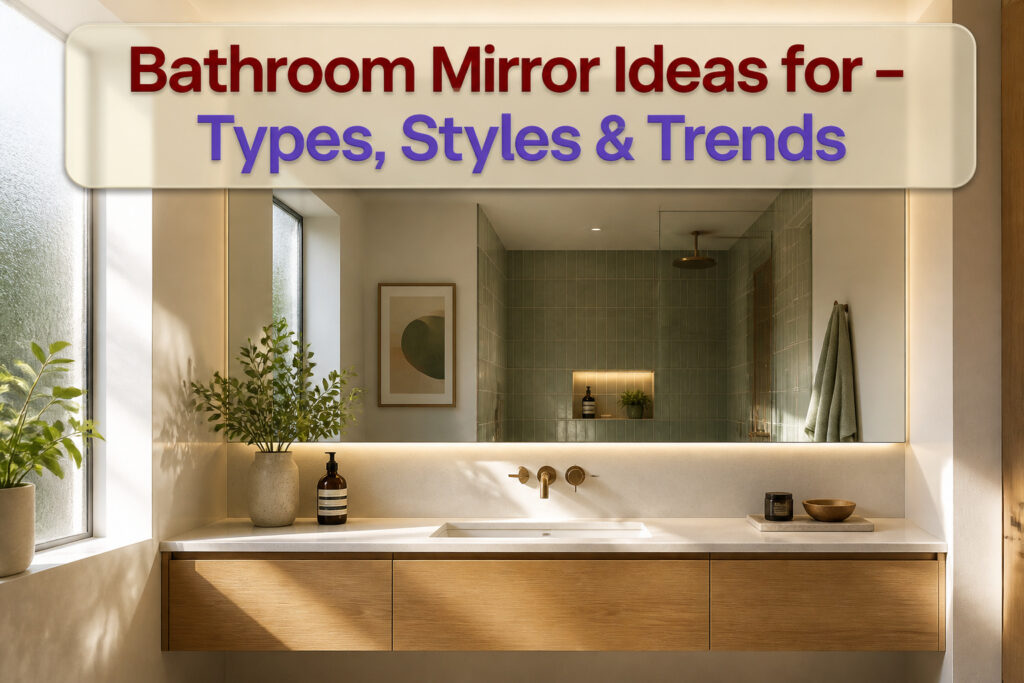
The right bathroom mirror idea for 2026 depends on whether you are renting for a year or renovating to stay. A frameless sheet glued to tile looks architectural but leaves holes that cost your security deposit; a bold framed piece uninstalls cleanly and still reads as intentional design. That same frameless panel, edge to edge between vanity and shower, doubled the visual depth of a white bathroom I kept returning to while researching this, without adding a single physical inch. Light bounces, walls step backward, and the mirror earns its wall space by doing actual spatial work rather than merely reflecting it.
1. Frameless Mirrors
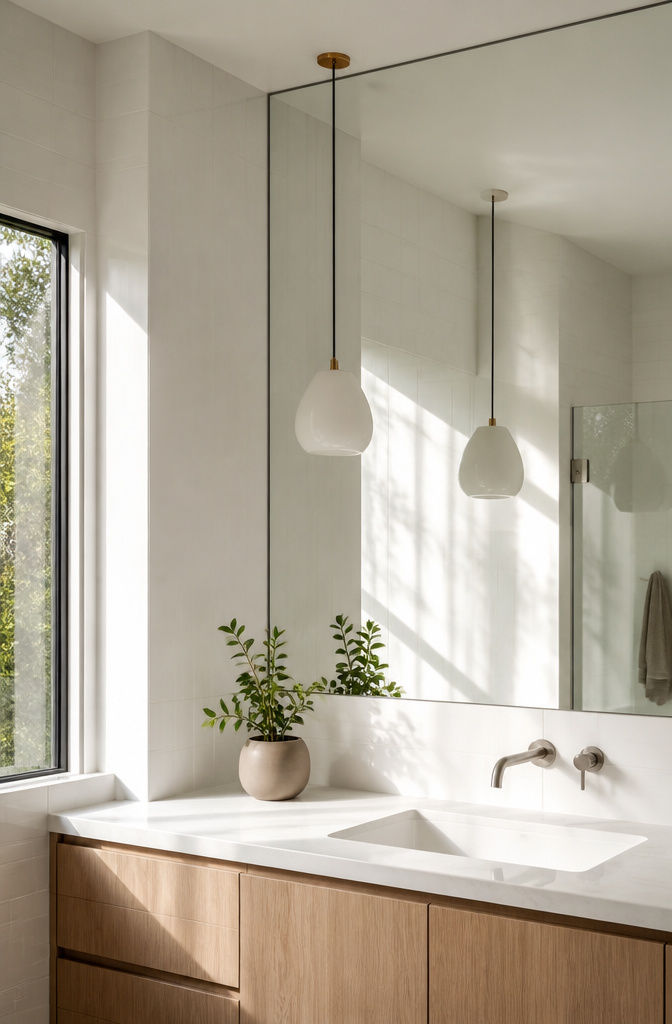
Frameless mirrors are the single most common recommendation across bathroom design guides, and the reason is immediate once you hang one: the glass meets the wall with no lip, no seam, no visual interruption. That absence of a frame lets the mirror disappear into the tile or paint behind it, which is exactly what a small bathroom needs. A bulky wood or metal frame would read as one more object in an already tight space; frameless glass just reads as light and depth.
The clean edge also suits the minimalist direction bathrooms have taken. Sources describe installations where the mirror runs full-bleed, edge to edge, for an architectural look that pairs with concrete, marble, or large-format tile. You are not fighting the wall treatment; you are extending it.
Shape is flexible. Rectangular is standard, but round and oval frameless mirrors hang just as well, and the hardware lets you turn them vertically or horizontally depending on what the wall demands. In one white bathroom I kept returning to while researching this, a single large frameless panel covered the entire wall between the vanity and the glass shower partition. The effect was that the room doubled in visual depth without adding a single physical inch.
The tradeoff is the finishing. Without a frame, the mirror edge is exposed, so the cut quality matters and the mounting clips or adhesive channel need to be precise. A frame forgives a wavy wall; frameless does not.

Upgrade Design: Our full length mirror is designed with HD float glass to deliver a clear reflection with no distortion; clear lines; simple modern design
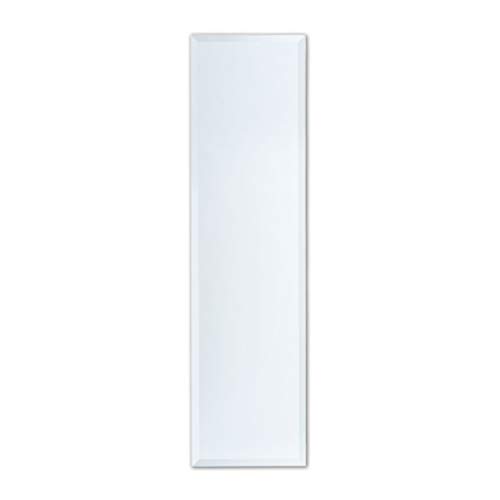
Classic, frameless, rectangular design is both simple and sophisticated, making a statement in any bathroom or bedroom

This standing mirror measures 56x20 inches. Suitable for bathrooms, bedroom, living room, behind the door, which can be mounted on wall,free standing. This full length mirror is a must-have for home improvement.
2. Round Mirrors
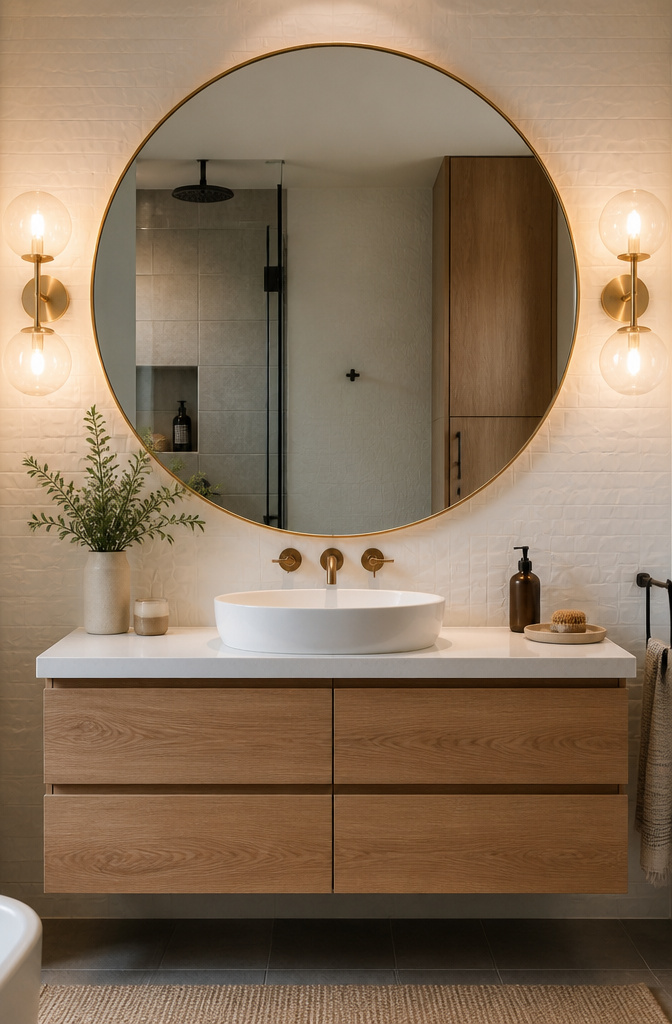
A round mirror does what a rectangle cannot in a small bathroom: it stops the eye at the edge instead of boxing it in. The curve softens the hard geometry of tile grids, cabinet corners, and angular sconces that dominate most builder-grade layouts. I keep noticing this in the compact baths I look at for ideas, where a round shape reads as open space even when the wall behind it is exactly the same size.
The effect works best when the mirror is large enough to matter. A 60-inch round over a vanity creates a sculptural focal point that pulls attention away from tight dimensions, especially paired with a wood frame that warms the room without adding visual weight. Bubble sconces in brass or gold finish layer light around the curve without competing with it.
For renters or anyone working with a weekend timeline, the installation is straightforward: one centered mounting point, no leveling of corners. The real judgment call is frame material. A wicker or rope hanger version against a wood accent wall adds texture but reads more casual; a slim metal frame keeps the look cleaner if your fixtures are already busy. Either way, the round form does the spatial work, not the decoration on it.

HD Bathroom Wall & Vanity Mirror: This tempered glass mirror delivers distortion-free clarity for makeup, shaving & more. Perfect over sinks or vanity tables, its steam-resistant, frameless design suits modern/classic decor. True-to-life reflections, zero warping—combines durability & style for daily prep. Elevate your bathroom with sleek, reliable clarity.

Large Bathroom Mirror: This is an oversized bathroom mirror that will add atmosphere to your bathroom.Simultaneously balancing practicality and decoration.

Oversized Flexible Fit: Hang vertically over 34" to 42" single vanities for a tall statement look, or horizontally over 60" to 72" wide vanity layouts for broader reflection and a more open, hotel-inspired bathroom feel
3. Backlit and LED Mirrors
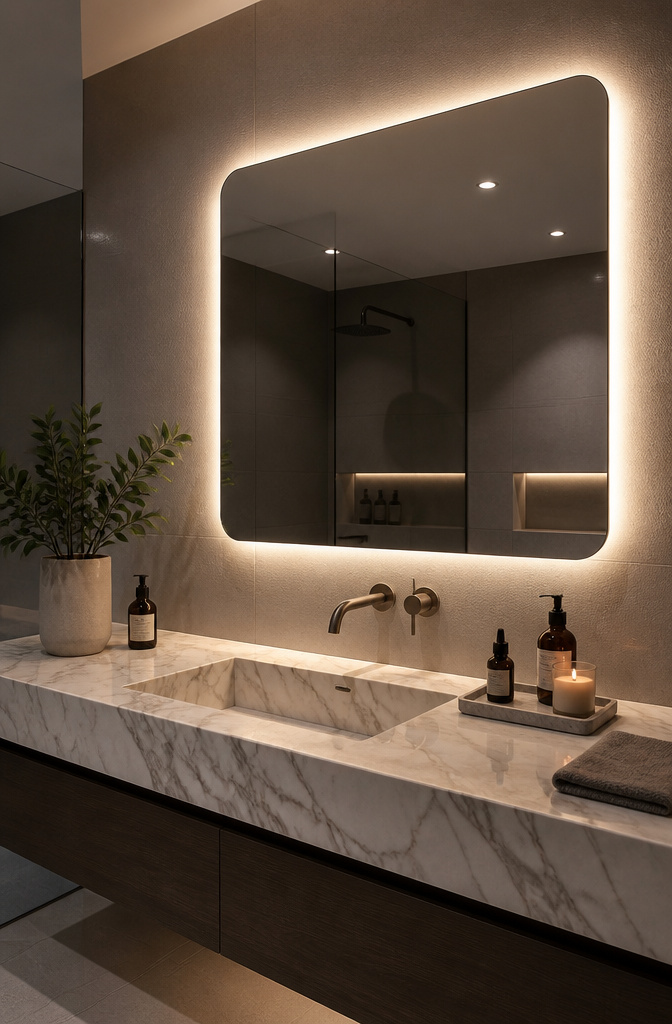
Soft, diffused light around the face makes the actual difference when you’re trying to line up eyeliner or catch every missed patch of stubble. Backlit mirrors mount the light source behind the glass itself, so the glow filters through rather than hitting you head-on. That placement matters more than brightness numbers ever will.
Perimeter LED strips, the kind that ring the frame, cast light forward into the room. Useful for ambiance, but they still leave shadows under your brow and jaw. Backlighting wraps the wall instead, and the wall becomes the reflector. Four designers I tracked across the sources landed on the same split: perimeter strips for a spa feeling when the lights are dim, backlit panels for the mirror you actually stand at to shave or put on makeup. The diffused quality reads as soft daylight, which is why grooming tasks look right under it rather than flattened or theatrical.
The practical catch is installation. Backlit mirrors need clearance behind the glass, so they sit slightly proud of the wall or require a recessed cavity. A surface-mount perimeter strip can go anywhere there’s a junction box. For a weekend project with a few hundred dollars, that usually decides it unless you’re already opening the wall.

Package: There are 1 roll 2 inch X 39 ft metal mirror frame sticker, thickened baseboard trim which are good textural and classical, very suitable for minimalist style home decoration

High-Definition Imaging: Made of quality acrylic material, it’s very smooth and has a good reflection. The thickness of 0.09" (2.5 mm) makes it not easy to warp and has a clear view at further distance than mirrors of 0.04"(1 mm). Overall size approx 30 x 40cm/ 11.81 x 15.75 in.

Dual Screws Mounted Hardware: The old designs are only can be fixed by one screw, but each of this new upgraded mounting hardware can be fixed by 2 screws. So the mirror will be more firmly fixed on the wall.
4. Corner Mirrors
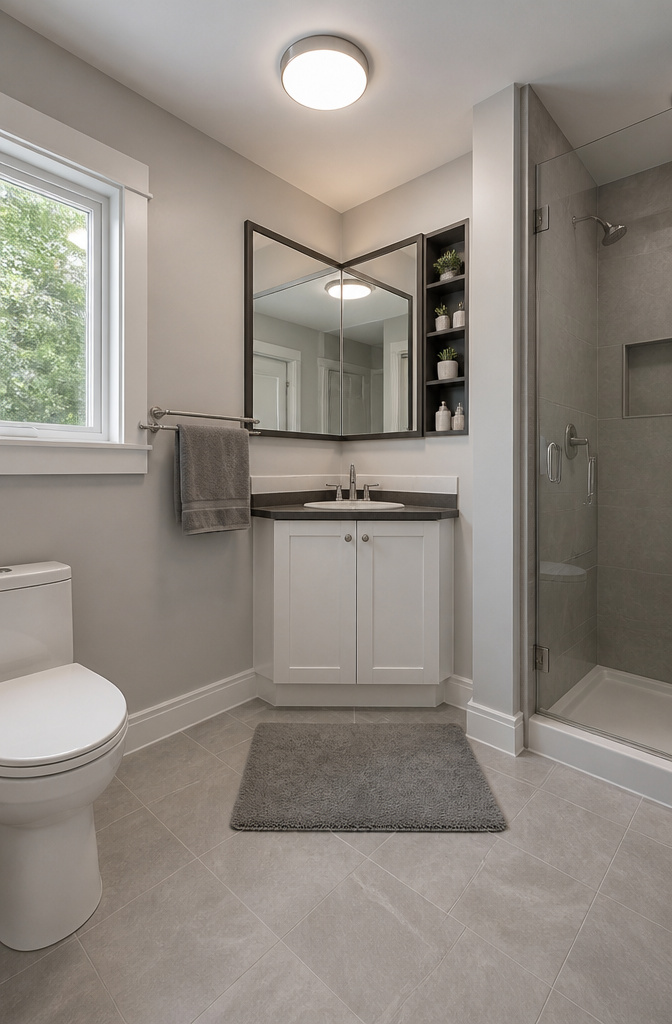
Corner mirrors sit where two walls meet, turning dead space into reflection in bathrooms that do not have much of either. The angled placement catches light from a window or vanity fixture and bounces it across both walls, which helps a tight powder room or L-shaped layout feel less boxed in. Many units come with a small shelf built into the frame, just enough for a toothbrush cup or a hand soap you actually use.
The real question is whether this mirror should be your only one. A corner mount sits off-center to the sink, so use it as a secondary mirror unless your vanity is tucked into that same corner. For a primary mirror you want face-on, level with the basin; otherwise you are shaving or applying makeup at a diagonal, which gets old fast. Installation means finding studs on both walls or using heavy-duty anchors rated for the weight, because a corner frame loads at an angle and tends to pull outward. I would not hang one over tile without a diamond bit and patience, or a plan to replace a cracked piece.

Wood Grain Pattern— Features a high‑definition wooden pattern flooring for a realistic, natural‑wood look

Large Fogless Shower Mirror: This shower mirror has a bigger reflective surface than other's for a crystal-clear view of your face and neck. This shower mirror features a special anti-fog coating that keeps your reflection clear—even in hot, steamy showers. No rinsing or wiping needed, so you can shave or groom without delay.

【Modern Mosaic Tile Appearance】Designed with layered blue square patterns that mimic real ceramic tiles, this wallpaper border brings a clean, structured look to wallpaper borders in bathrooms, kitchens, or backsplash zones.
5. Double Vanity Mirrors
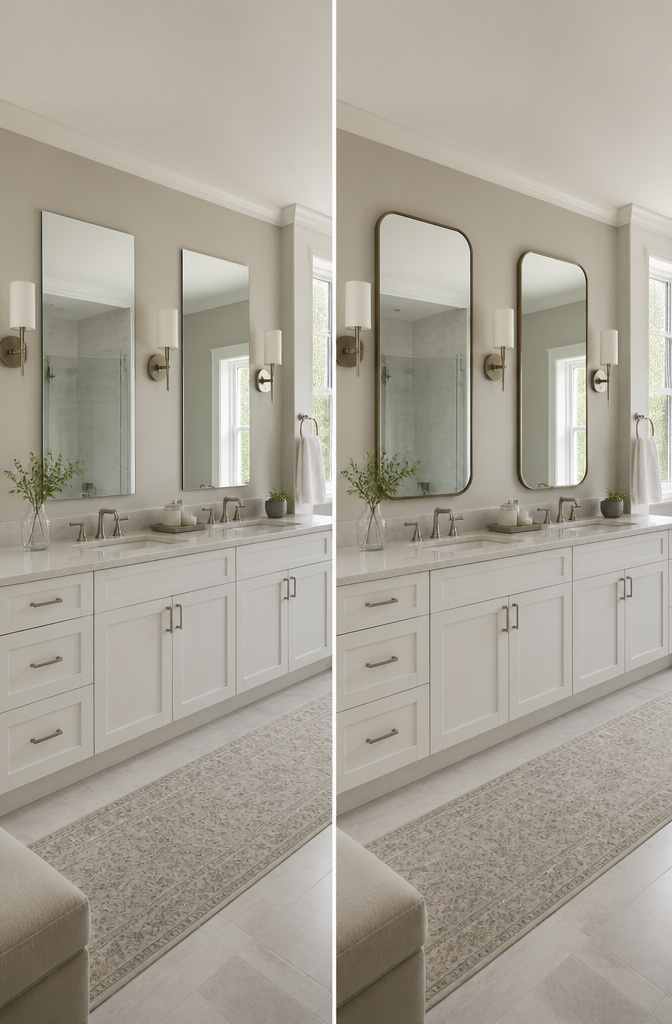
Twin vertical mirrors above each sink and one oversized mirror spanning the full width are the two setups worth weighing for a double vanity. The twin route wins when your sinks sit at least 36 inches apart measured center to center; anything tighter and the gap between frames starts to feel like a wall of punctuation rather than a pair of windows. I learned that spacing rule the hard way after helping a friend install two 24-inch framed mirrors on a 54-inch vanity. The three-inch gap looked cramped, and we ended up swapping for a single frameless panel that same weekend.
A single oversized mirror, especially frameless, anchors the wall and draws the eye upward in a way twin mirrors rarely manage. It also bounces more light around if you can place it opposite a window or even a decent houseplant. The catch is shared real estate: one person standing at the sink blocks the reflection for the other, and you lose the chance to tilt or adjust individually. For renters, twin mirrors hung on cleats are easier to take down and patch around than a 60-inch slab of glass. If you own and plan to stay, the spanning mirror reads as intentional architecture rather than two purchases that happened to match.
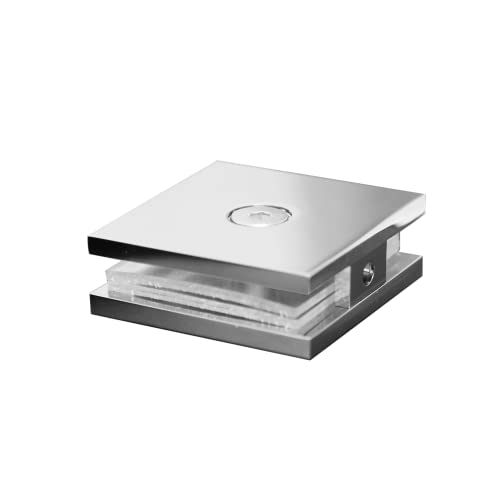
Fits 5/16-3/8 in Glass: This shower glass clamp fits 5/16 in to 3/8 in glass, or 8mm to 10mm. It is suitable for frameless shower glass panels, fixed glass screens, bathroom glass partitions, and other fixed glass panel installation projects.

PREMIUM 3/8 INCH THICK TEMPERED GLASS - Heavy-duty safety glass with beveled edges delivers exceptional durability and modern elegance. Significantly reduces breakage risk while creating a spacious, contemporary bathroom aesthetic that customers love.

PREMIUM 3/8 INCH THICK TEMPERED GLASS - Heavy-duty safety glass with beveled edges delivers exceptional durability and modern elegance. Significantly reduces breakage risk while creating a spacious, contemporary bathroom aesthetic that customers love.
6. Smart Mirrors
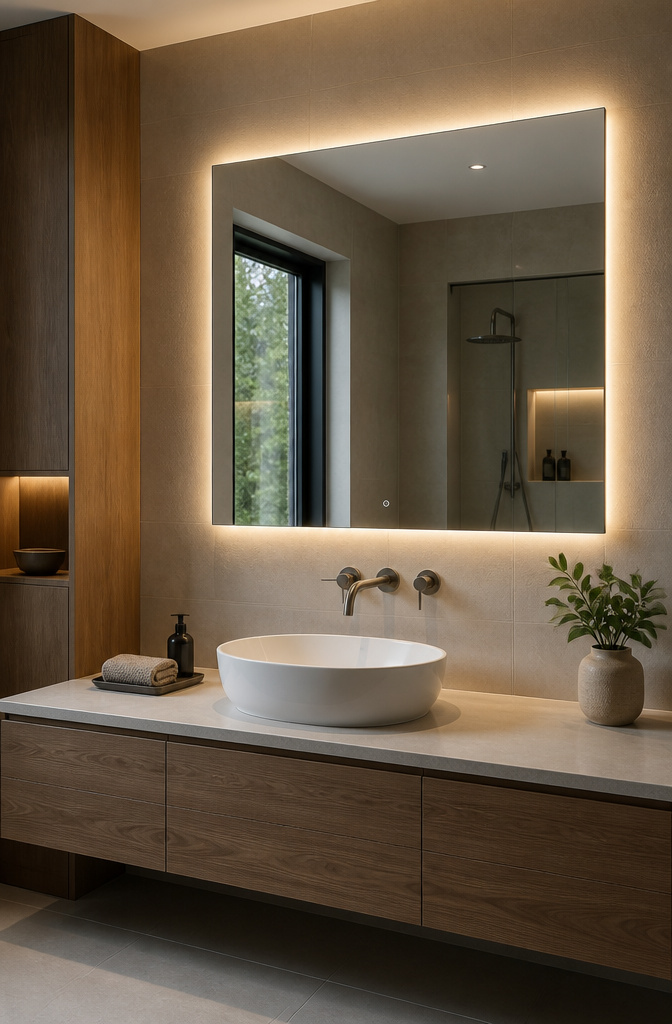
Smart mirrors pack the most tech into the smallest wall space in your bathroom. Defoggers and voice-activated controls show up on most models now, and after reading how owners actually use them, the defogger is the only feature I’d call essential. The heated pad behind the glass keeps the center clear after a shower, which matters on a rushed weekday. Voice controls for lights or music sound useful until you remember you’re standing at a sink with wet hands and a running faucet, shouting at a mirror. Built-in Bluetooth speakers and temperature displays fall into the same category: fun for the first week, then ignored.
The practical combo is a smart mirror with adjustable color temperatures that mimic natural daylight for makeup or grooming, plus that anti-fog pad. Some units add edge-lit or backlit illumination that gives the mirror a floating effect and throws even, shadow-free light on your face. Storage is trickier. A few smart mirrors integrate a medicine cabinet behind a frameless façade, but the slim profile limits how much you can actually fit inside. If you’re choosing between a smart mirror and a separate cabinet, the mirror wins for a powder room where you only store a few basics; for a master bath, you’ll probably need both.

✅Sleek & Modern Frameless Design: This 1/4“ thick frameless full length mirror features an elegant beveled edge that elevates any space. It’s a stylish wall mirror full length that complements both traditional and modern decor seamlessly.

for small space and opening up your room.the Door mirror light weight also makes it ideal on the door mirror. It gives you a full image either on the back of a door or on the wall.,Suitable For Everyday Use.

Gorgeous! That’s what your loved ones will say when they unwrap this unexpected gift. With a full-length frameless mirror and a roomy, built-in space, they’ll compliment you on your choice of such a classic, 2-in-1 jewelry cabinet with a brown finish
7. Full-Wall Mirrors
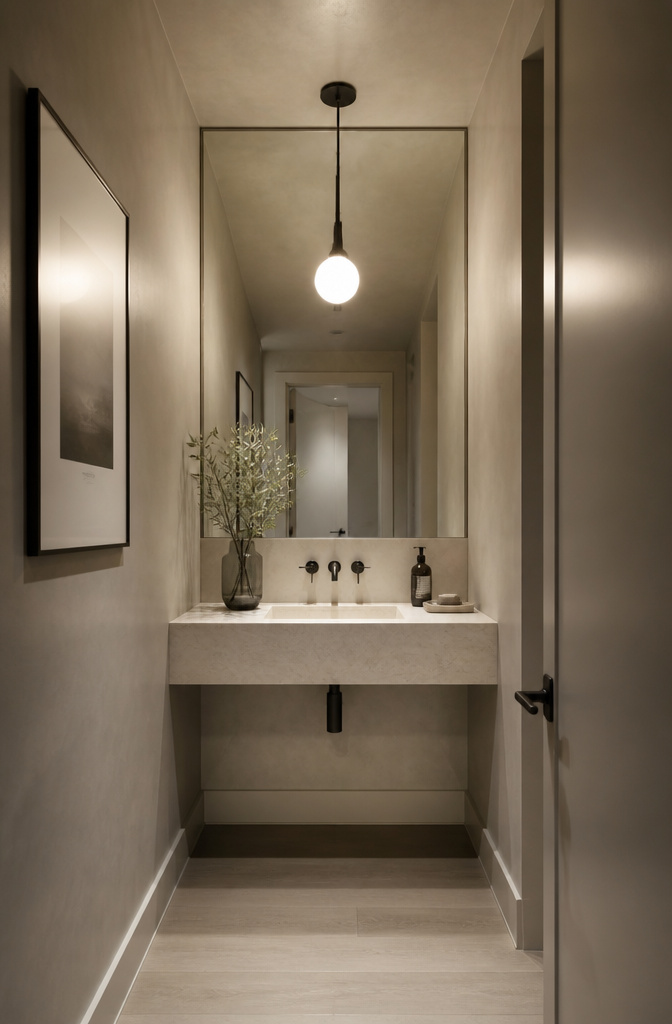
A full-wall mirror turns the narrowest bathroom into something that breathes. Light from a single window bounces twice, sometimes three times, before it fades, and the wall itself seems to step backward. I have seen this work in a windowless powder room where the mirror sat opposite a skylight shaft; the space read as daylight rather than cave.
The installation is where the fantasy meets your lease. Frameless sheets need adhesive and a few anchored clips, which leaves screw holes that matter if you move out in a year. Some landlords will accept the patch job; others deduct without discussion. If you rent, a single large framed mirror on a cleat system is safer, though it sacrifices that seamless, spa-wall look the hotels pull off.
Cost splits the same way. A custom frameless install runs toward the professional end, while a ready-made framed piece in the 60-inch range lands in the few-hundred zone most weekend budgets allow. Either path, the mirror wants to sit opposite whatever light source you have, or the trick collapses into mere reflection of your own face at 7 a.m.

【Dual Lighting Design ,Backlight + Frontlight】This LED bathroom mirror features both backlight and frontlight for ultra-bright, even illumination—perfect for makeup, skincare, shaving, and outfit checks.

GOLD FRAME : Unique gold frame seamlessly blends into any modern home decor,Adding a touch of luxury and warmth to your home decor,the golden coating enhances the light reflection effect, making your room look more spacious and bright.It is not only a practical product, but also a work of art that enhances style.
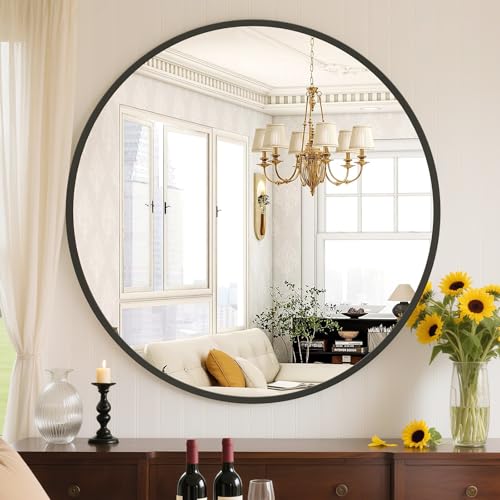
Crystal-Clear HD Reflection with Zero Distortion: Crafted with silver-plated high-definition glass, this vanity mirror delivers a sharp, true-to-life reflection with no warping or visual distortion—for makeup application, grooming, and everyday use
8. Vintage Mirrors
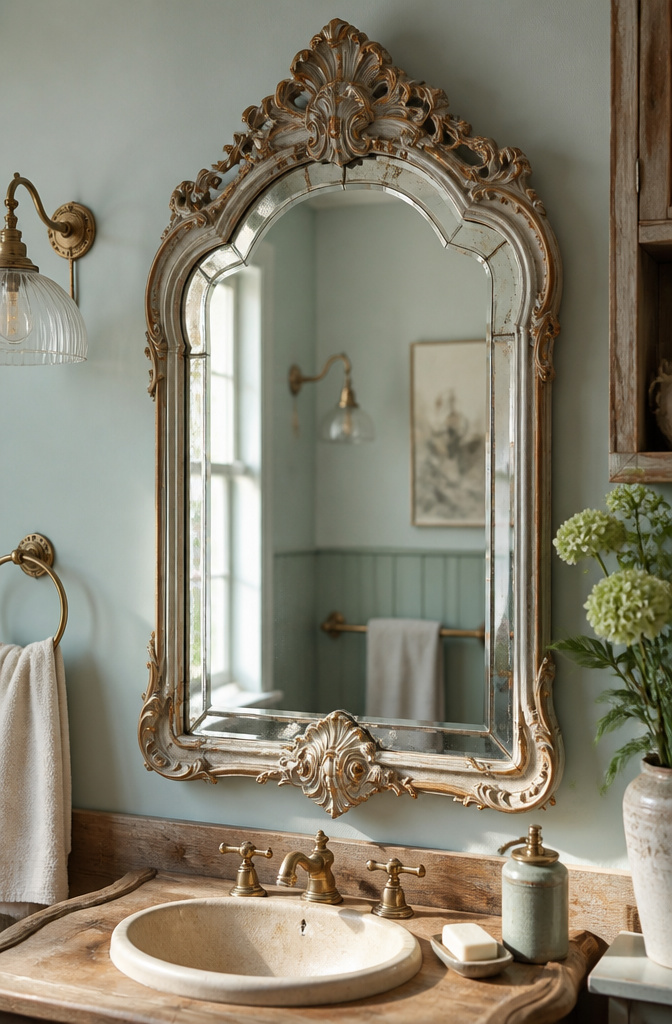
Ornate details and beveled edges are what separate a vintage mirror from a frame that merely looks old. The real pieces carry weight in the carving: acanthus leaves, rope twists, or a soft patina that no spray can convincingly fake. Brass fixtures or distressed wood nearby pull the same thread through the room, and a hit of gold or copper against the glass highlights the old-world appeal without turning the bathroom into a set piece.
Sourcing one takes patience. Thrift stores and flea markets turn up frames with the right wear, though the mirror itself may need replacing if the silvering has flaked. Check the back for pressed marks or stamps that place the piece; a genuine antique frame usually has hardware that was set by hand. I pass on anything with fresh glue squeezing from a corner repair, since the humidity in a bathroom will open that seam again within a season. If the glass is original and clouded, a local glazier can cut a new beveled edge to match for less than the cost of a reproduction frame that weighs half as much and looks it.

Acrylic Material: The self adhesive mirror is made of acrylic material that has a smooth surface and a good texture,Which is safer and can avoid scratches and will not break; Equipped with self-adhesive stickers that can be glued to smooth walls.Each mirror sticker is attached with a protective film on the front side,tearing off the film can show the reflection of the mirror.

Acrylic Material: The self adhesive mirror is made of acrylic material that has a smooth surface and a good texture,Which is safer and can avoid scratches and will not break; Equipped with self-adhesive stickers that can be glued to smooth walls.Each mirror sticker is attached with a protective film on the front side,tearing off the film can show the reflection of the mirror.

Acrylic Material: The self adhesive mirror is made of acrylic material that has a smooth surface and a good texture,Which is safer and can avoid scratches and will not break; Equipped with self-adhesive stickers that can be glued to smooth walls.Each mirror sticker is attached with a protective film on the front side,tearing off the film can show the reflection of the mirror.
9. Farmhouse Mirrors
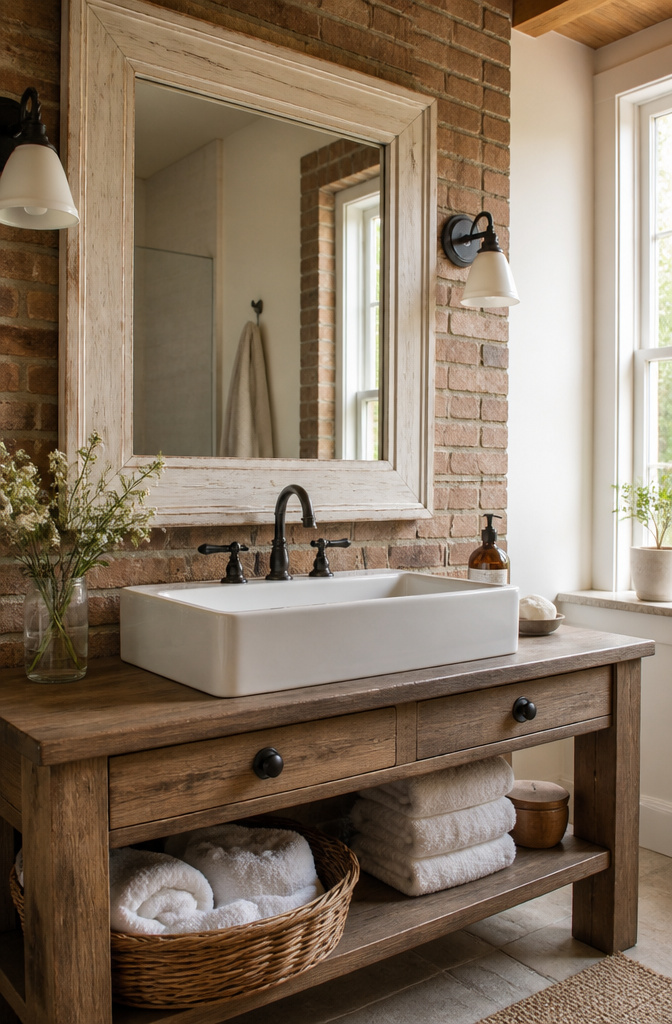
Thick wooden frames with a whitewashed finish are the clearest signal of farmhouse style in a bathroom mirror. The frame should look hand-hewn, maybe with a subtle arch at the top, and the wash should read as deliberate wear rather than accidental water damage. What separates this from general rustic is the restraint: cottage tends toward delicate beadboard details, raw rustic leaves the wood bare and rough, but farmhouse sits in the middle with a frame substantial enough to hold its own against shiplap or textured walls without fighting them for attention.
A thick frame only works if you want it to be the focal point. In a bathroom where the vanity hardware, the light fixture, and the mirror all compete, something has to lose. I would rather see the farmhouse mirror paired with a simple iron sconce and a quiet faucet than watch three statement pieces cancel each other out. The warmth it brings matters most in rooms dominated by hard surfaces; tile and porcelain can run cold fast, and the wood frame does the softening that a textile would do anywhere else.
If your wall is already busy, scale the mirror up so the frame width feels proportional, not apologetic. A narrow band of wood on a wide mirror above shiplap looks like a mistake, not a choice.

【Clear Reflection & NO Distortion】: LOAAO bathroom vanity mirror is designed with HD float glass to deliver a clear reflection with no distortion; clear lines; simple modern design

HD ACRYLIC MIRROR: Made of acrylic, treated with a special process to enhance durability, provides clear reflections and not easy to break. It enhances natural light in your space, making rooms feel brighter and wider

Mosaic Tile Aesthetic: This HOMETITUTE wallpaper border mimics blue ceramic mosaic tiles, adding fresh texture and visual interest to kitchen backsplashes, bathroom walls, or sink surroundings.
10. Bold Framed Mirrors
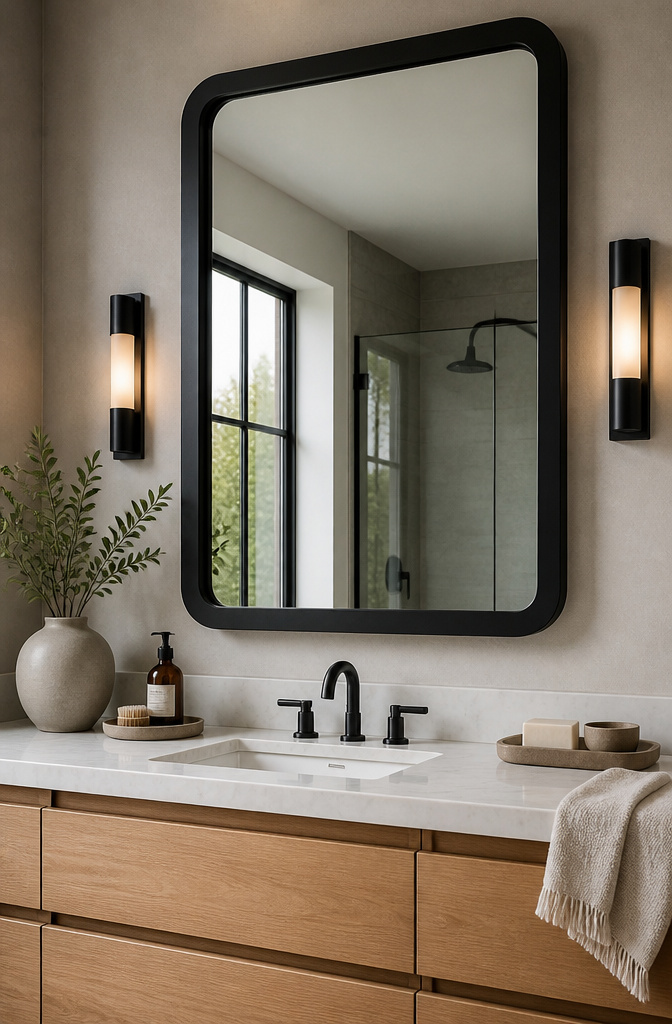
A mirror with a bold frame stops being a background object and starts acting like deliberate furniture. The frame width matters more than the finish: a thick border, whether rustic wood or sleek metal, reads as intentional rather than an afterthought. Color works two ways. Black, brass, or even colored finishes turn the mirror into the room’s showpiece, and the sources back this with three distinct directions. Leather-wrapped edges, acrylic, or natural stone inlays add texture that survives a weekend install. The real decision is whether to match or fight the fixtures. Matching black frames to black vanities and shower hardware gives a clean, pulled-together look. Contrasting works too: a gold-framed mirror against a dark vanity, or a warm wood frame against cool metal, creates the tension that makes a small bathroom feel designed rather than assembled. Double framing, like a gold metal piece layered with gold elements, pushes this further but needs the wall space to breathe. For renters and first-home owners, a bold frame is the fastest way to make a basic builder-grade bathroom look considered, and it uninstalls cleanly when you move.

PREMIUM 3/8 INCH THICK TEMPERED GLASS - Heavy-duty safety glass with beveled edges delivers exceptional durability and modern elegance. Significantly reduces breakage risk while creating a spacious, contemporary bathroom aesthetic that customers love.

LUXURY SHOWER - Experience luxury with the Madeira Series Grid Pattern Shower Screen, a fixed panel designed to elevate your showering experience.

STURDY CONSTRUCTION: Solid brass glass clamp provides lasting durability and a premium feel, with a corrosion-resistant finish that withstands wear and scratches, keeping glass panels secure even in wet environments
11. Integrated Mirror Cabinets
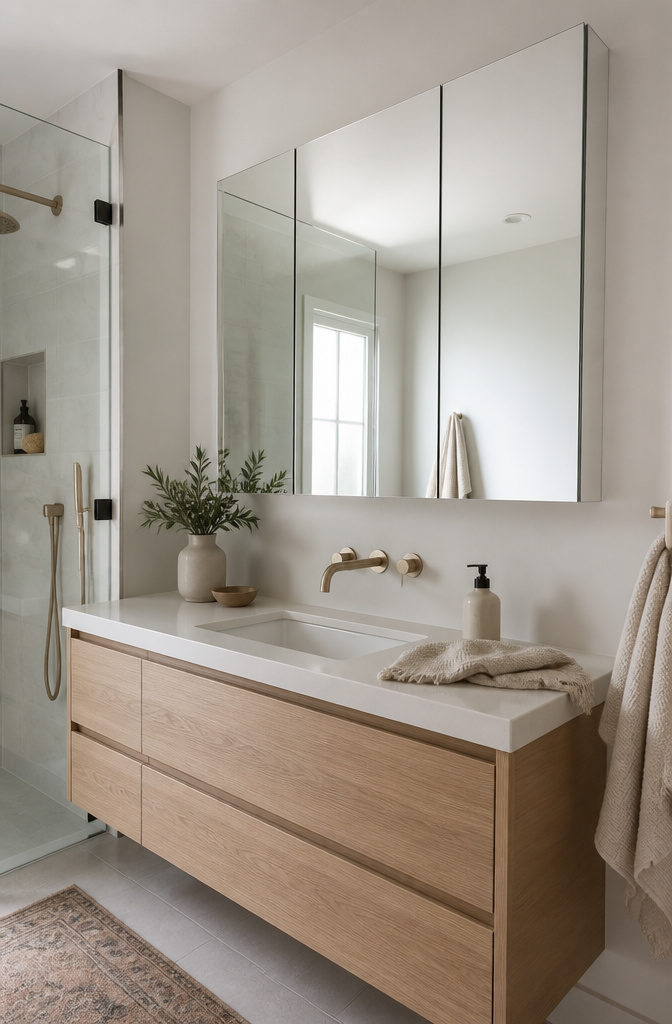
Touch-to-open panels and soft-close drawers have quietly become the features that separate a modern mirror cabinet from the medicine chest your landlord installed in 2003. The storage itself is real, but the depth is shallower than a standard recessed medicine cabinet, so bulky bottles and spare toilet paper still need a closet. What you gain is concealment behind a frameless mirrored façade that reads as pure wall, not utility, which suits minimalist or Scandinavian-inspired bathrooms where every visible edge counts. The tradeoff is worth it if your toiletries are mostly tubes and small containers; it falls short if you stockpile Costco-sized shampoo.
12. Floating Mirror Panels
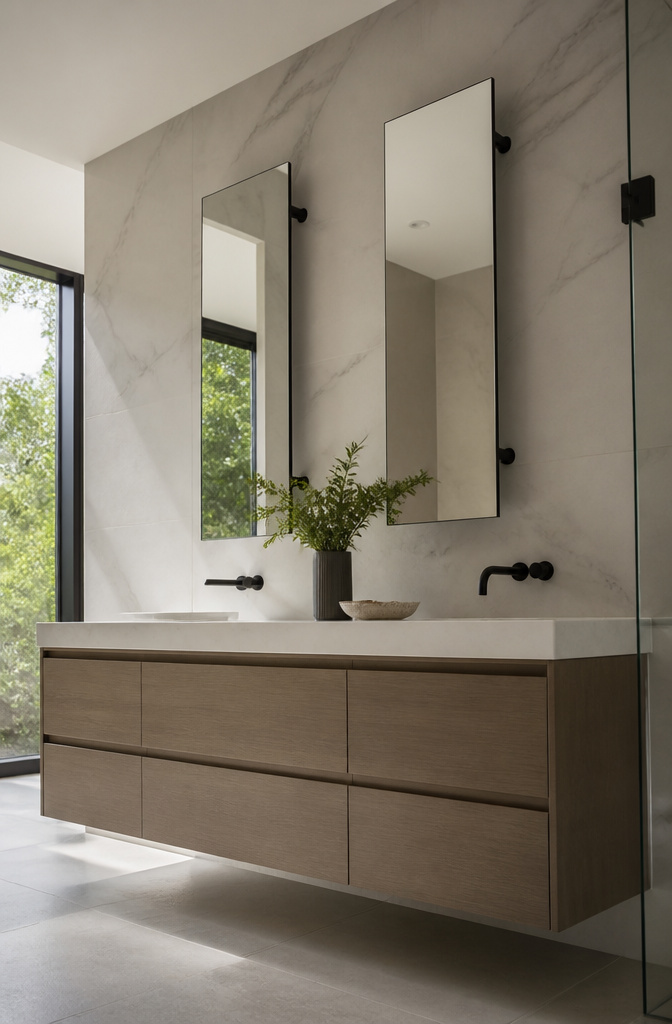
The suspended look of floating mirror panels comes from mounting hardware that stays visible, often thin cables or slim brackets in black, brass, or chrome that become part of the design rather than hidden away. That hardware has to carry the full weight of the glass, so wall backing matters more than with a standard framed piece. Most panels this size need anchoring into at least two studs or solid blocking behind the drywall, not just toggle bolts, since the cantilevered load pulls differently than a flush-mounted mirror.
These mirrors read as airy and modern, almost hovering off the surface, which works well with underlit vanities and light marble where you want depth without bulk. The tradeoff is the installation: you are balancing the panel, holding hardware true, and checking level while the glass is live. Two anchor points is the minimum and also the common spec, which makes floating panels less common than framed or glued options but worth noting if you want something that sits between a full wall mirror and a simple hung piece.
13. Coastal-Inspired Mirrors
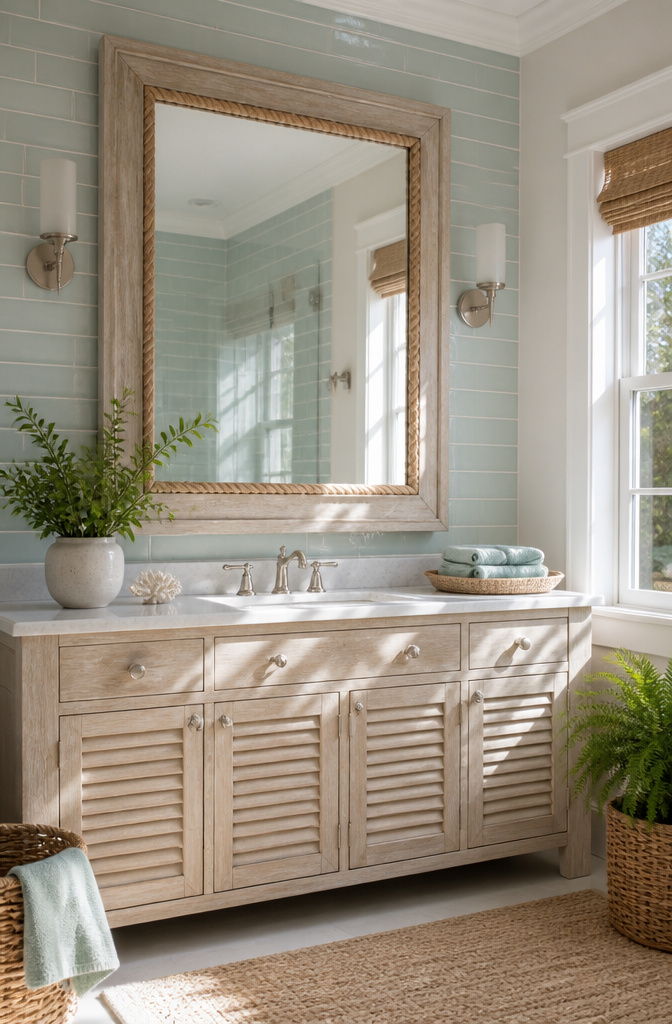
Distressed wood frames and rope detailing carry the seaside look without sliding into kitsch, but the material choice matters more than the motif. Solid hardwoods finished with marine-grade sealant hold up to bathroom humidity far better than the soft, porous woods that look weathered because they actually are. I have seen too many "nautical" mirrors warp at the corners within a single humid summer.
The arched, thin black frame from the modern beach setup offers a cleaner alternative. It reads coastal through pairing, not through literal rope or anchor shapes. That orange clay tile and wood vanity combination works because the mirror stays restrained; it fills the white wall without competing.
If you want the full rope-and-weathered-wood effect, keep it to powder rooms that see lighter use, or accept that the frame will need refinishing every few years. Pale blue accents and sea-glass tones in the frame itself age better than rope, which traps moisture at the back where you will not notice the damage until the mount loosens.
14. Industrial Frame Mirrors
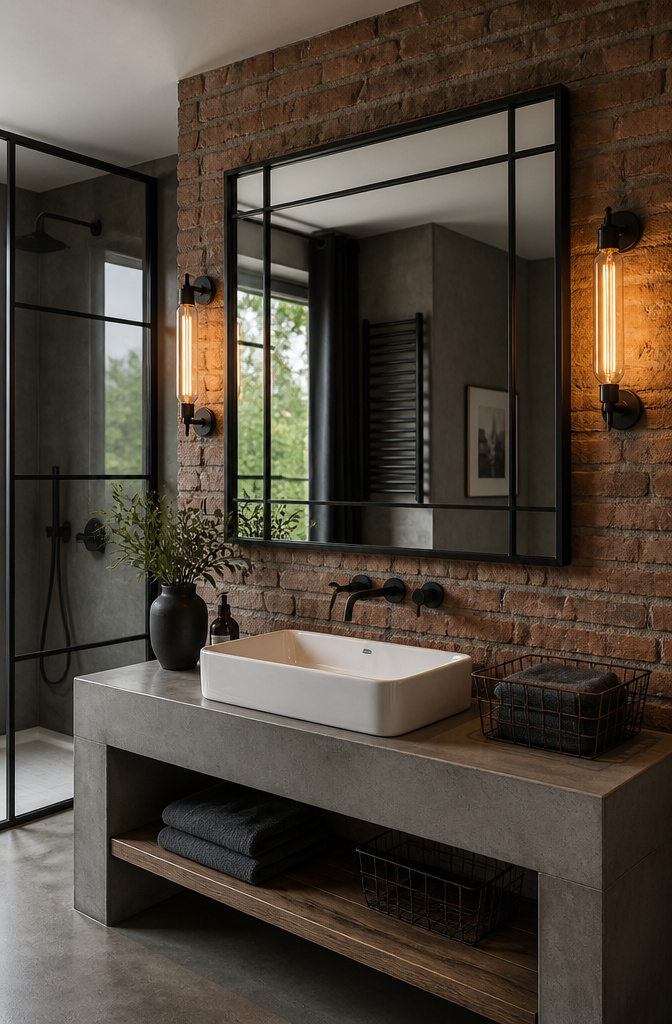
Black iron and brushed nickel are the materials that signal industrial style, and the difference from farmhouse or rustic comes down to line weight and finish. Industrial frames run heavier, with strong rectangular shapes and grid-like construction that reads as engineered rather than salvaged. Farmhouse might whitewash the same metal or soften it with curves; industrial leaves the weld marks and lets the surface stay raw.
The look works best where the bathroom already has some existing grit: exposed brick, concrete floors, or at least matte black faucets that echo the frame. Edison bulbs nearby help the mirror feel intentional rather than like a piece of loft furniture that wandered into the wrong room. For a DIY route, repurposed pipe builds the same aesthetic with hardware-store parts, though the weight means you need real wall anchors, not the plastic kind that come in the mirror box.
A grid-frame mirror over a double vanity needs to span the full width or it looks undersized; two narrower rectangles read as separate pieces and break the line you are trying to draw across the wall.
15. Asymmetrical Mirrors
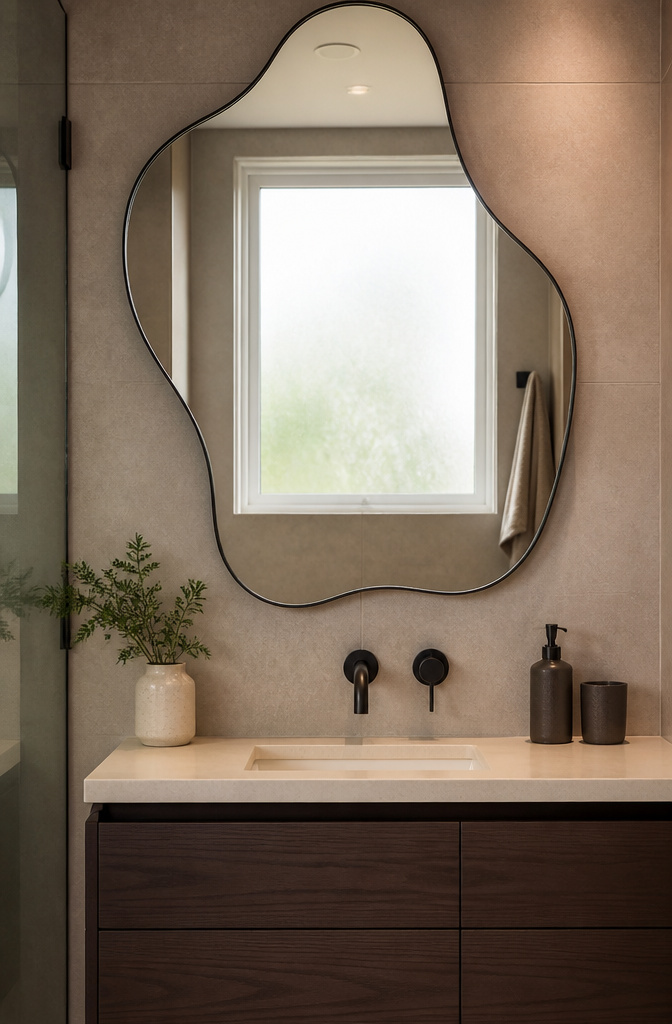
Asymmetrical and wavy mirrors are showing up everywhere right now, part of the broader shift toward curvy, rounded shapes in home decor. A freeform silhouette softens the hard edges bathrooms tend to collect: tile lines, vanity corners, shower enclosures. The look feels modern without trying too hard.
The catch is mounting. Most asymmetrical pieces have their hanging point offset from the visual center, so the bracket location on the back does not match where the mirror’s weight appears to sit. You will need to find the stud or use a heavy-duty anchor, then level the piece by eye rather than by measuring equal distances from the vanity edges. I have seen friends spend twenty minutes with a stud finder only to realize the bracket lands exactly between two studs, forcing a toggle bolt or a plywood backing board.
If the wavy shape feels like too much, an arched or curved-top mirror gives a similar softness with a more predictable install. Both options work in small spaces where curves help the room feel visually open rather than boxed in.
What Mirrors Actually Do in a Bathroom
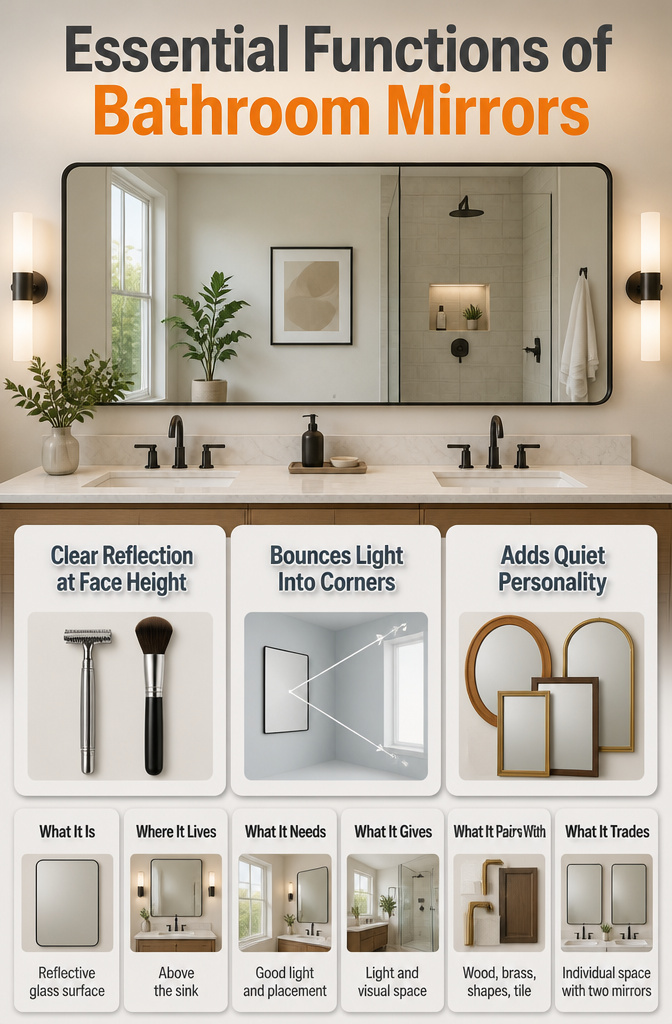
A bathroom mirror has to earn its wall space three ways before style even enters the conversation. The first is grooming: shaving, makeup, checking whether that thing on your neck is a mole or a smudge. Most of us need a clear reflection at face height with enough light to catch details, which is why the mirror’s placement relative to your sink and any window matters more than its frame finish.
The second job is spatial trickery. A mirror bounces whatever light the room gets, natural or otherwise, back into corners that would otherwise stay dim and compressed. In a small guest bath, that reflection can flatten the back wall visually and buy you a few inches of perceived breathing room. In a primary bath with double sinks, two separate mirrors cut the reflection into strips and break the illusion; one spanning mirror keeps it continuous, though you sacrifice the individualized drop zone.
The third layer is the one that gets skipped in builder-grade installs: the mirror as the room’s quiet personality. Wood frames warm up cool tile. Brass softens the hard edges of a typical bathroom’s angles and plumbing. Even the shape, round or arched against a sea of rectangles, does more to set tone than most fixtures twice the price. The mirror is where you look most mornings. It might as well be something worth looking at.
Where Bathroom Mirrors Are Heading
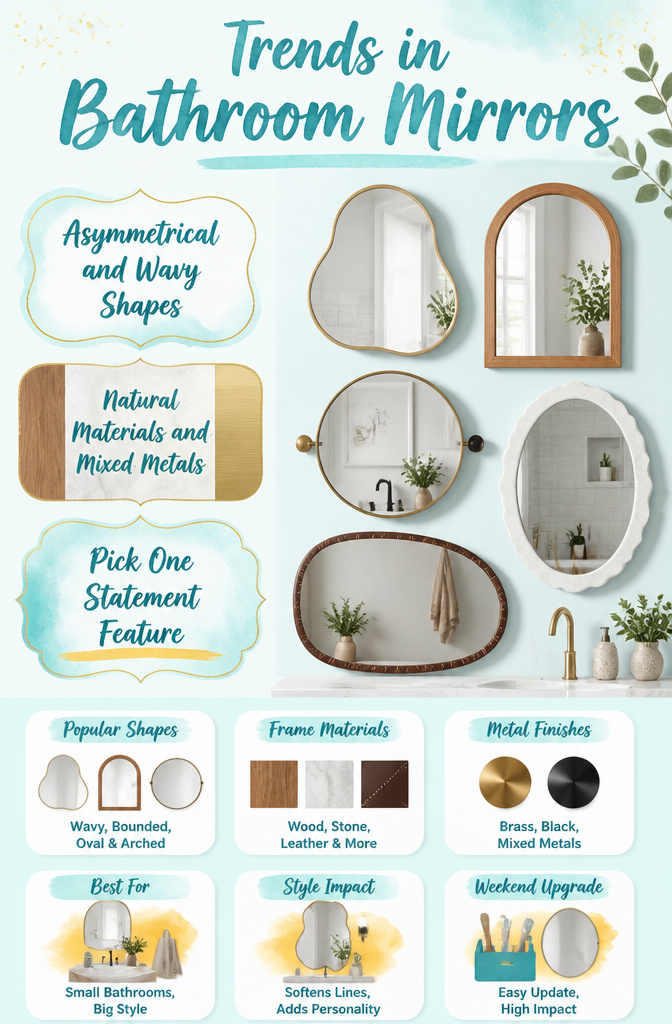
Asymmetrical and wavy mirrors are everywhere right now, and the squiggle or scalloped edges I mentioned earlier fit this moment exactly. They soften the hard lines that tile and cabinetry leave behind, which is why I keep seeing them paired with the rounded-top and oval mirrors I already listed. If you want the freeform look without going full wavy, an arched or curved-top frame gets you most of the way there.
The same 2026 push toward personal expression is pulling in natural materials and mixed metals. Wood frames, stone inlays, and leather-wrapped edges are showing up on the bold framed mirrors I covered, while brass paired with black hardware turns a simple round mirror into something intentional. The trick is picking one statement and letting the rest stay quiet. I would not mix a wavy silhouette, a wood frame, and mixed metals all in one small bathroom. Two of those layers is plenty for a space you finish in a weekend.
Hinged and Adjustable Mirrors
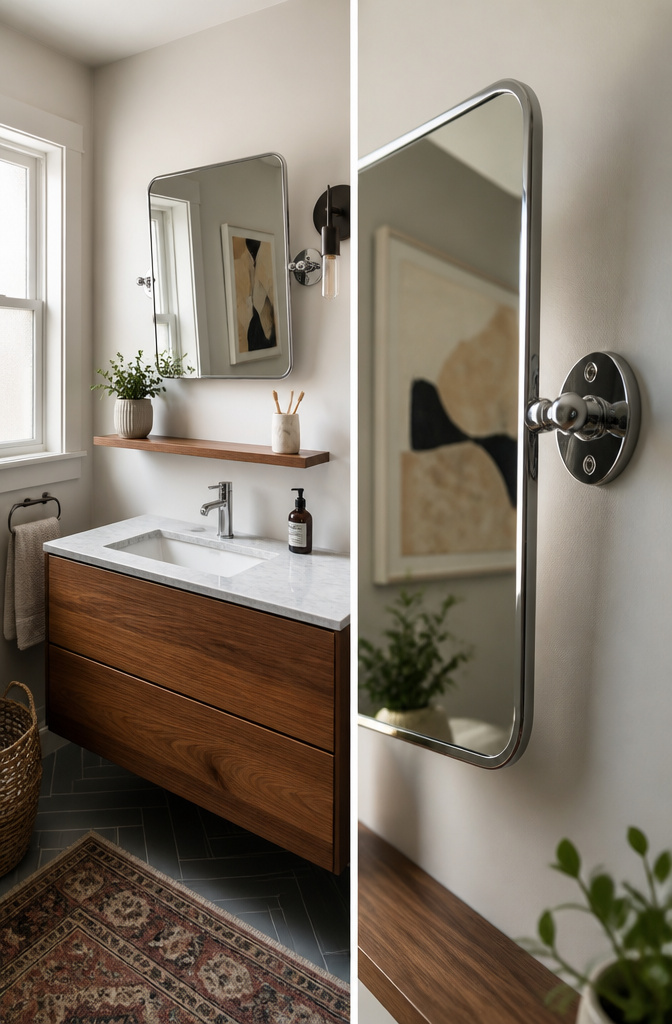
Hinged mirrors solve the one problem a fixed mirror never can: the angle. In a shared bathroom, a 5’2" morning routine and a 6’1" one share the same wall, and tilting the glass beats craning your neck or hunching at the sink. The hardware mounts like any framed mirror, but the side brackets let you pitch the top forward or back. I would not bother in a powder room guests use twice a year, but for a couple’s daily bath it is the kind of small fix that stops a daily annoyance.
Floating mirror shelves pull the same double duty in tighter spaces. The mirror sits on the wall with a shallow shelf below it, maybe six inches deep, enough for a toothbrush cup or a small plant without the bulk of a full cabinet. It reads as intentional in a half-bath where a medicine chest would crowd the room, and the open shelf keeps essentials in sight rather than behind a door you forget to close. The catch is dust: anything you display there needs to be something you do not mind wiping now and then, or the shelf becomes clutter you see every time you wash your hands.
Frequently Asked Questions
What are the current bathroom mirror trends?
Asymmetrical and wavy mirrors with scalloped or squiggle edges lead 2026 bathroom design, softening the hard lines of tile and cabinetry. Arched, oval, and curved-top mirrors offer a similar contemporary feel for anyone not ready for full freeform shapes. Natural materials like wood and stone, plus mixed metals such as brass paired with black hardware, are also showing up across styles.
What type of mirror is best for bathrooms?
The best mirror depends on how you use the space and what style you want. Frameless panels suit minimalists and small bathrooms because they disappear into the wall. Backlit or LED mirrors work for grooming since they cast even, shadow-free light on your face. Smart mirrors with defoggers help on rushed mornings, while bold framed or vintage pieces add personality where the bathroom otherwise reads as builder-grade.
How can I maximize space in a small bathroom with mirrors?
Corner mirrors turn dead wall junctions into reflection and often include a shallow shelf for toiletries. Frameless mirrors read as light rather than objects, so the room feels larger. A single large mirror spanning a wall bounces daylight deeper into the space than two smaller pieces would.